
The person or company that draws a set of house plans owns the copyright in them, unless a signed written agreement says otherwise. The client who pays for the plans normally receives a license to build the house, not ownership of the design. That is the short answer to who owns house plans under U.S. copyright law, and it surprises many homeowners who assume that paying for the drawings means owning them.
This article explains the rule, what a client does get, and the questions to settle in writing before design begins. It is general information for Wichita-area homeowners and builders, not legal advice. For a specific dispute, talk to a Kansas attorney who handles copyright matters.
Who owns house plans: what the law says
Three federal sources answer most questions.
| Source | What it says |
|---|---|
| Architectural Works Copyright Protection Act | House designs created on or after December 1, 1990 are protected as architectural works |
| U.S. Copyright Office Circular 41 | Protection covers the overall form of the building and the arrangement of spaces. The plans are also protected separately as technical drawings |
| 17 U.S.C. 204(a) | A transfer of copyright ownership is valid only if it is in writing and signed by the owner |
Put together, the default is simple. The author of the plans owns them from the moment they are drawn. Ownership moves to someone else only through a signed document. A paid invoice, an email saying thanks or a set of printed sheets in your truck does not transfer the copyright.
Who is the author?
The author is the person who created the design. Circular 41 notes one exception, a work made for hire. When an employee draws plans as part of the job, the employer is the author. That is why a builder with an in-house drafter owns the plans its staff produces. A plan drawn by an independent designer for a client is generally not a work made for hire, so the designer remains the owner.
What the client gets: a license
If you do not own the copyright, what did you pay for? You paid for a design service and a license to use the result. The scope of that license comes from your agreement. Terms vary, and common ones cover:
- The right to build the house one time
- On one specific lot
- Using printed sets and PDF files for bidding, permits and construction
- With changes made by, or approved by, the original designer
Anything beyond the license needs permission. Building the same house a second time, selling the plans to a friend or handing them to another drafter to rework are the three situations that cause most disputes.
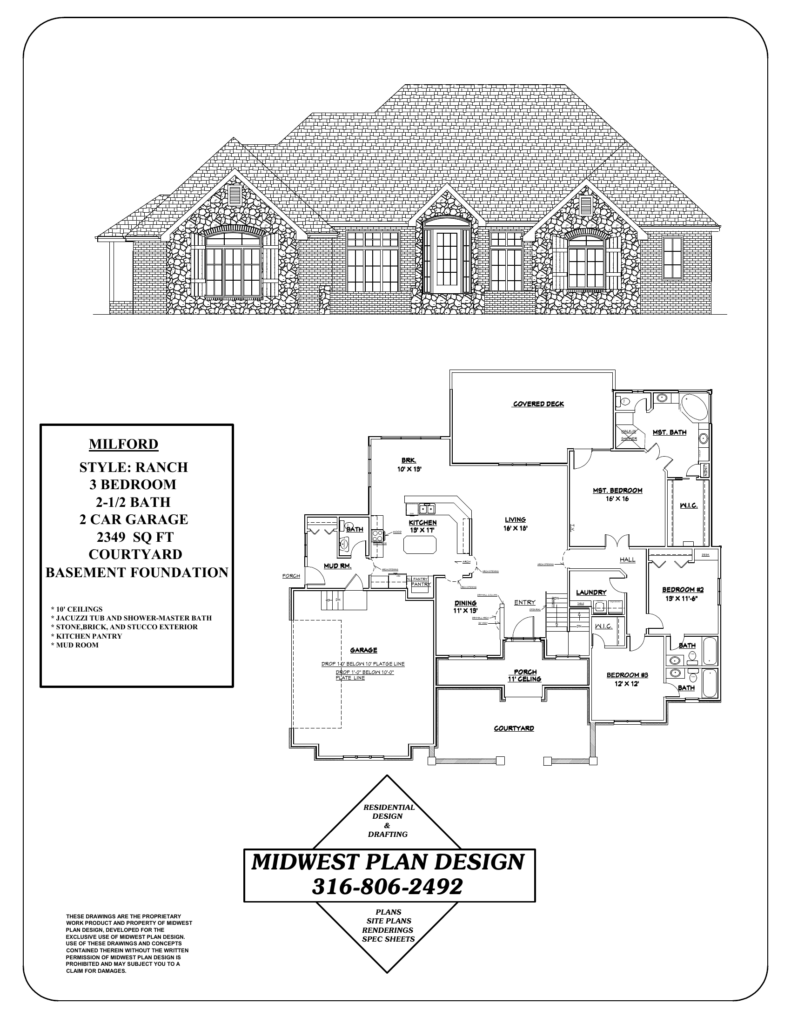
Plan sheets in the MidWest Plan Design portfolio carry a notice like that. It states that the drawings are the firm’s property and may not be used without written permission. A notice is not required for copyright to exist, but it tells everyone who picks up the sheet where things stand.
What copyright does not cover
Copyright protects a specific design, not the idea behind it. The Copyright Office lists items that are not protected on their own:
- Standard features such as common windows, doors and other staple building components
- Standard configurations of spaces
- Purely functional elements
So nobody owns the concept of a ranch with a split-bedroom layout, a three-car garage or a covered patio. A designer can draw you a new plan with those features. What a designer cannot do is trace or closely reproduce someone else’s floor plan and elevations.
Common situations in the Wichita area
You found a plan online or in a model home
Showing it to a designer as inspiration is fine. Asking for a copy is not. The honest routes are to buy a license from the plan’s owner or to have a new design drawn around the features you like. Our comparison of custom vs pre-designed residential floor plans covers both.
Your builder drew the plans
If a design-build company’s staff drew them, the company likely owns them. Many builders will not release their plans for another contractor to build. Ask before you sign anything. If you want the freedom to collect bids, hire an independent designer first. See can you take house plans to any builder.
You want to change plans someone else drew
Changing a plan creates what the law calls a derivative work, and the right to make one belongs to the copyright owner. Go back to the original designer or get written permission. Our article on how to modify existing house plans explains the practical side.
You are selling or remodeling the house
The house is yours. Under 17 U.S.C. 120, the owner of a building may alter it or tear it down without the designer’s consent, and anyone may photograph a building that is visible from a public place. Selling the house does not hand the buyer the right to build a second copy.
You want the house to stay one of a kind
By default, the designer can reuse a design. If you want exclusivity, or want to own the copyright outright, negotiate it and put it in a signed agreement. Expect that to affect the fee.
Questions to settle in writing before design starts
- Who owns the copyright when the plans are finished?
- How many times may the house be built, and on which lot?
- May I send the plans to any licensed builder for bids?
- Will I receive PDF files, printed sets or CAD files?
- Who may revise the plans later, and at what cost?
- May the designer reuse or publish the design?
- What happens to my rights if the project stops partway?
Clear answers protect both sides.
Does a plan need to be registered?
No. Copyright exists as soon as the work is created. Registration with the U.S. Copyright Office is optional, but under 17 U.S.C. 411 the owner of a U.S. work generally has to register before filing an infringement lawsuit. Circular 41 explains how a building design and its drawings are registered as separate works.
Frequently asked questions
Do I own my architect’s drawings?
You own the physical copies and the right to use them as your agreement allows. The architect or designer keeps the copyright unless it was transferred to you in a signed writing.
Who owns the rights to architectural plans?
The author who created them, or the author’s employer if the plans were drawn by an employee as part of the job.
Can you draw your own house plans without an architect?
In Kansas, yes. K.S.A. 74-7031 exempts people who prepare plans for one and two family dwellings from the architect license requirement. The plans still have to meet the building code. See home designer vs architect in Kansas.
What do you call a person who designs house plans?
A residential designer, home designer or building designer. An architect is a design professional licensed by the state. Gary Wilbert of MidWest Plan Design is a residential designer with more than 30 years of experience. Read what a home plan designer does.
Is it illegal to copy a floor plan?
Copying a protected plan without permission can be copyright infringement. Using general ideas and standard features in a new design is not.
Sources
- Circular 41: Copyright Registration of Architectural Works, U.S. Copyright Office
- Execution of transfers of copyright ownership, 17 U.S.C. 204, Cornell Legal Information Institute
- Scope of exclusive rights in architectural works, 17 U.S.C. 120, Cornell Legal Information Institute
- Registration and civil infringement actions, 17 U.S.C. 411, Cornell Legal Information Institute
- K.S.A. 74-7031, Kansas Office of Revisor of Statutes
Ask the ownership question at the first meeting
MidWest Plan Design draws custom house plans for homeowners and builders in the Wichita area. Bring your questions about plan use, builders and revisions to your consultation and get the answers before work begins. Call 316-806-2492. You can also review the questions to ask before hiring a residential home designer.